


At one time I thought the most important thing was talent. I think now that the young man or the young woman must possess or teach himself, train himself, in infinite patience, which is to try and to try and to try until it comes right.
— William Faulkner
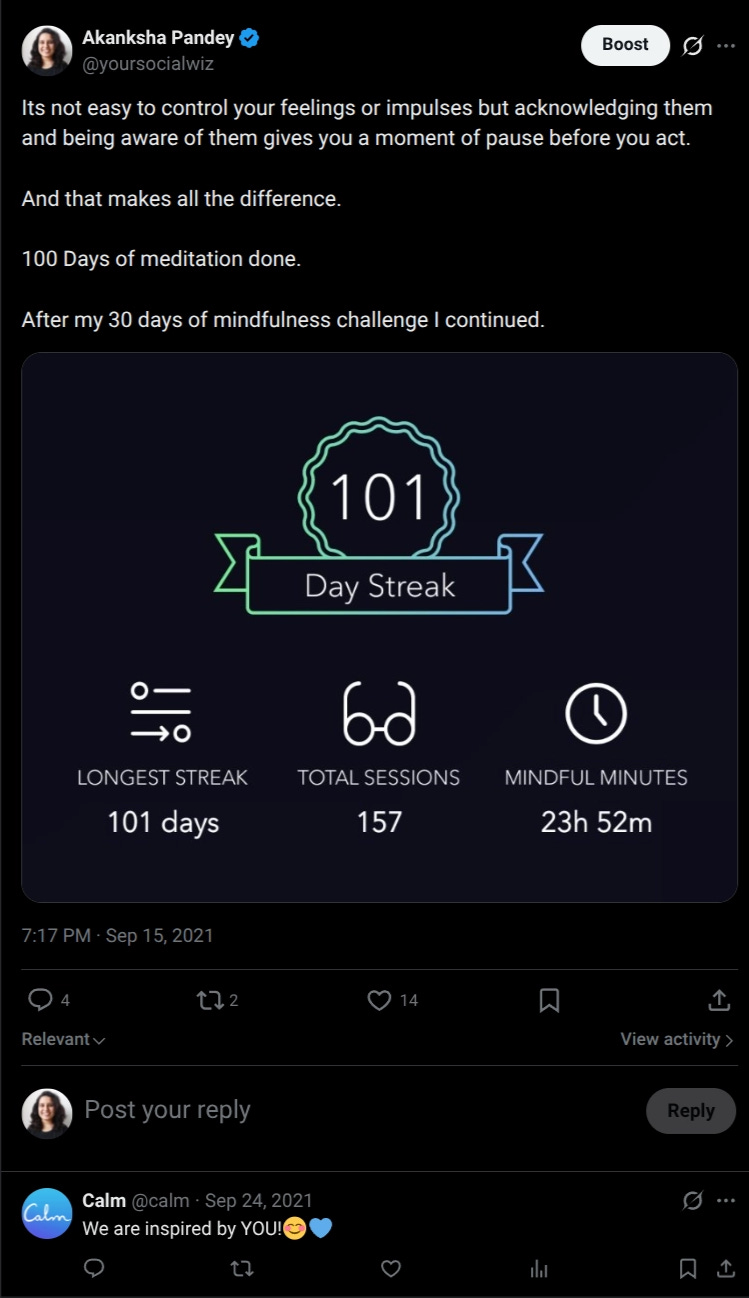
Lately I have this strong urge to live by challenges. I did this back in 2021. I used to come up with monthly challenges like:
100 days of meditation
30 days of hosting morning spaces on Twitter at 6 AM
30 days of Running.. etc.
This time I am going to challenge myself to
write daily + Reach out to 10 people / day
for 30 days
This is my way of chasing the white light. More on this in a minute.
Right now it’s time for the monthly reflection of May. A collection of things that made me stop and say, “Woah!”
Reading White Holes
Buddha Quote
Writing with fountain pen
Painting like a kid
1. Reading White Holes
I first saw the image of black hole in 2019. It looked beautiful to me. The burning yellow ring with a dark patch that sucks anything in.
I imagined all the wild stories where the main character gets sucked into the black hole. But after that I couldn’t think of dramatic way to get them out.
Every version of the story I came up with ended with, “You go far enough inside the black hole, find some magical loop hole and get kicked out of the black hole into the universe with a repel force.”

I never considered another possibility.
What if the only way out was through?
That’s the idea, I was introduced to from the book White Holes.
Theoretically, if you do get sucked into the black hole. You have to keep going. That’s the only way out. The black hole is basically formed by burning dying star. There’s light at the end of black hole that will push you out.
The book is a fascinating read. You realize how scientific discoveries are built on top of each other.
One generation asks a question, the next generation answers it and discovers 3 more questions.
In 18th century, Newton constructs modern physics. He imagines all objects have a natural motion (an idea of aristotle) at a constant speed (an idea of Galileo) in a physical space described by Euclidean geometry (an idea of his own).
Right now, White holes exist in theory. Just like how Black holes existed in theory.
There was a time when Mendeleev predicted the existence of undiscovered elements with absolute accuracy.
Eka-aluminium was discovered 5 years later as Gallium
Eka-boron was discovered 10 years later as Scandium
Eka-silicon was discovered 17 years later as Germanium
2. Buddha Quote
Read this, read this well and take a pause after reading it.
If you meet the Buddha on the road, kill him.
When I first read it in the White Holes book, I threw my Kindle away.
This was said by Linji Yixuan, a great Chinese master of Buddhism. Why the heck would he something like this?
He said that to destroy any spiritual dependency or conceptual rigidity, any fixed idea, image or external authority of enlightenment you cling to.
Even the Buddha can become an obstacle to your direct lived awakening.
We know Gautam Buddha & Siddhartha to be the same person. But in the book Siddhartha by Hermann Hesse, Gautama & Siddhartha are two different people.
Siddhartha is the protagonist who is in search of enlightenment & Gautam is the learned person who is enlightened.
Siddhartha gets an opportunity along with his friend Govinda to meet Gautama. Govinda gets impressed by Gautama and becomes his disciple.
Siddhartha is also impressed by Gautama but he leaves.
Few years back, I didn’t understand his reason of leaving. Not until I read this quote of killing Buddha.
Siddhartha realized that Gautama’s teaching can describe enlightenment, point toward enlightenment, inspire enlightenment but it cannot transfer enlightenment itself.
The Buddha attained awakening through his own direct experience. The direct experience is what Siddhartha was looking for.
If Siddhartha follows another person’s path, he will end up knowing about enlightenment rather than discovering it for himself.
After leaving, Siddhartha becomes wealth. He gambles, chases pleasure, lives with a prostitute. Eventually, he falls into despair & nearly commits suicide.
From a conventional spiritual perspective, this can look like failure. But Hesse’s point is that Siddhartha needed all of this lived experience to know by himself.
3. Writing with a fountain Pen
The first time I tried using Fountain pen was in school. I got it as a birthday present.
I was super excited to try it out. I carefully filled the ink and started writing. I don’t remember if I liked it or not because it stopped working. I jerked the pen, like you do with normal pens to make it work.
That my friend spilled the ink on me and my friend’s crisp white shirts. That was the day it was decided. NEVER AGAIN!
But as Justin Beiber said, “Never say never baby!”
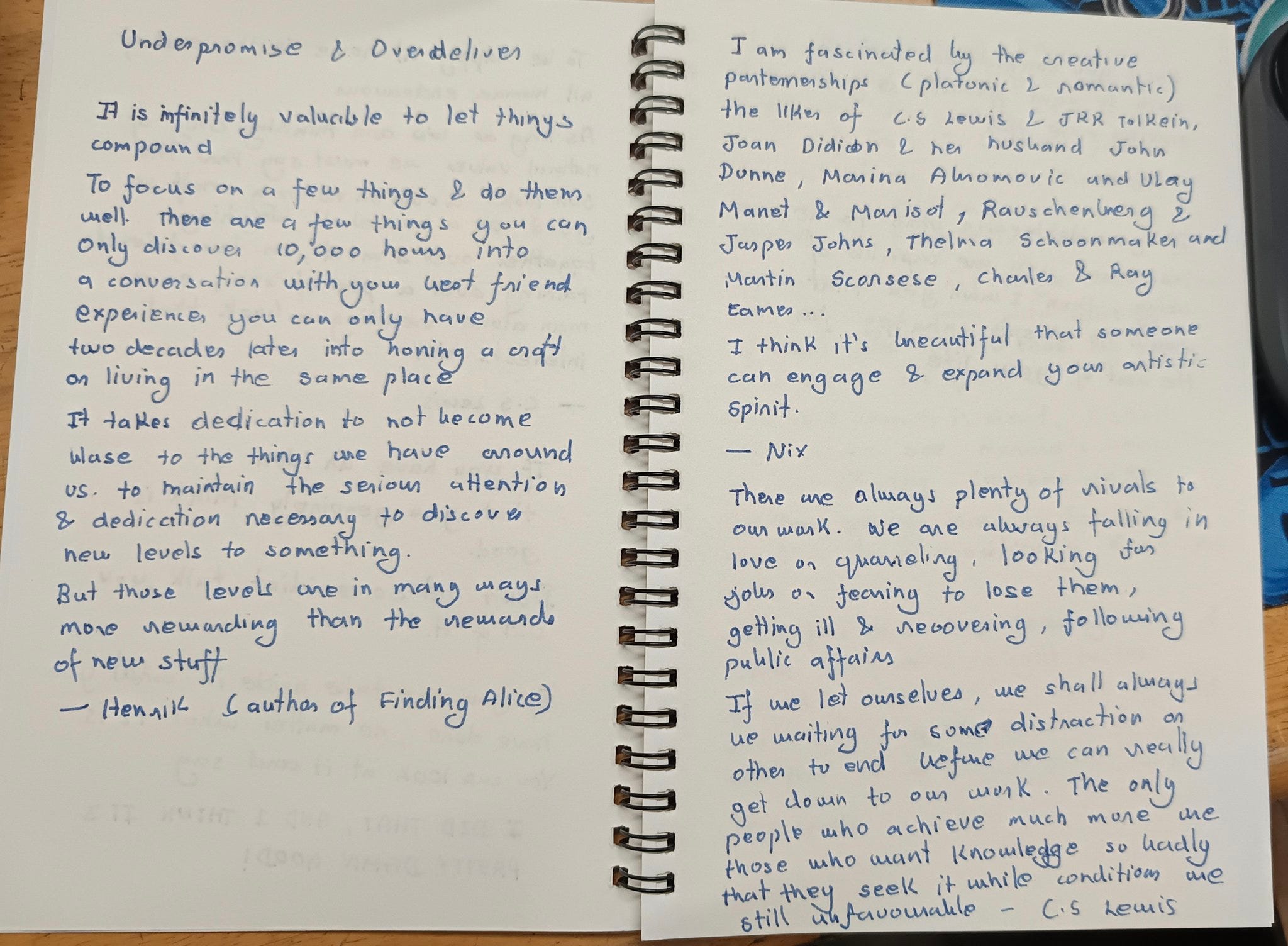
In the last 2 months, I have been writing a lot on paper. So at some point, ball point pens, no matter how smooth stopped doing it for me.
I wanted a pen that glides on paper. AI suggested Fountain Pen. And I said, Let’s try it out.
I am still getting a hang of it. But Woah! The way it flows on paper is super addictive.
I got Preppy Platinum Fountain Pen 0.5 mm pen. Seems like a pretty good start, if you want to try writing with a fountain pen.
4. Painting like a kid
I was on a call with a recently introduced friend. She is an artist. She showed me some of her beautiful paintings. I was so amazed by them that I had to ask her,
“Did you go to an art school?
She said, “No, it started like everyone else. Parents put you into drawing class when you are a kid. Everyone else stopped drawing, I didn’t.”
We had a discussion made a pact around how she will post more of her artwork on Instagram and I will start painting again.
And Damn bro, painting has been humbling. I am learning a lot of patience. My sister says, I paint like a kid. Judge for yourself:


If you know any good painting teachers, courses, or resources for beginners, send them my way.
